How to Build Business Credit the Right Way.
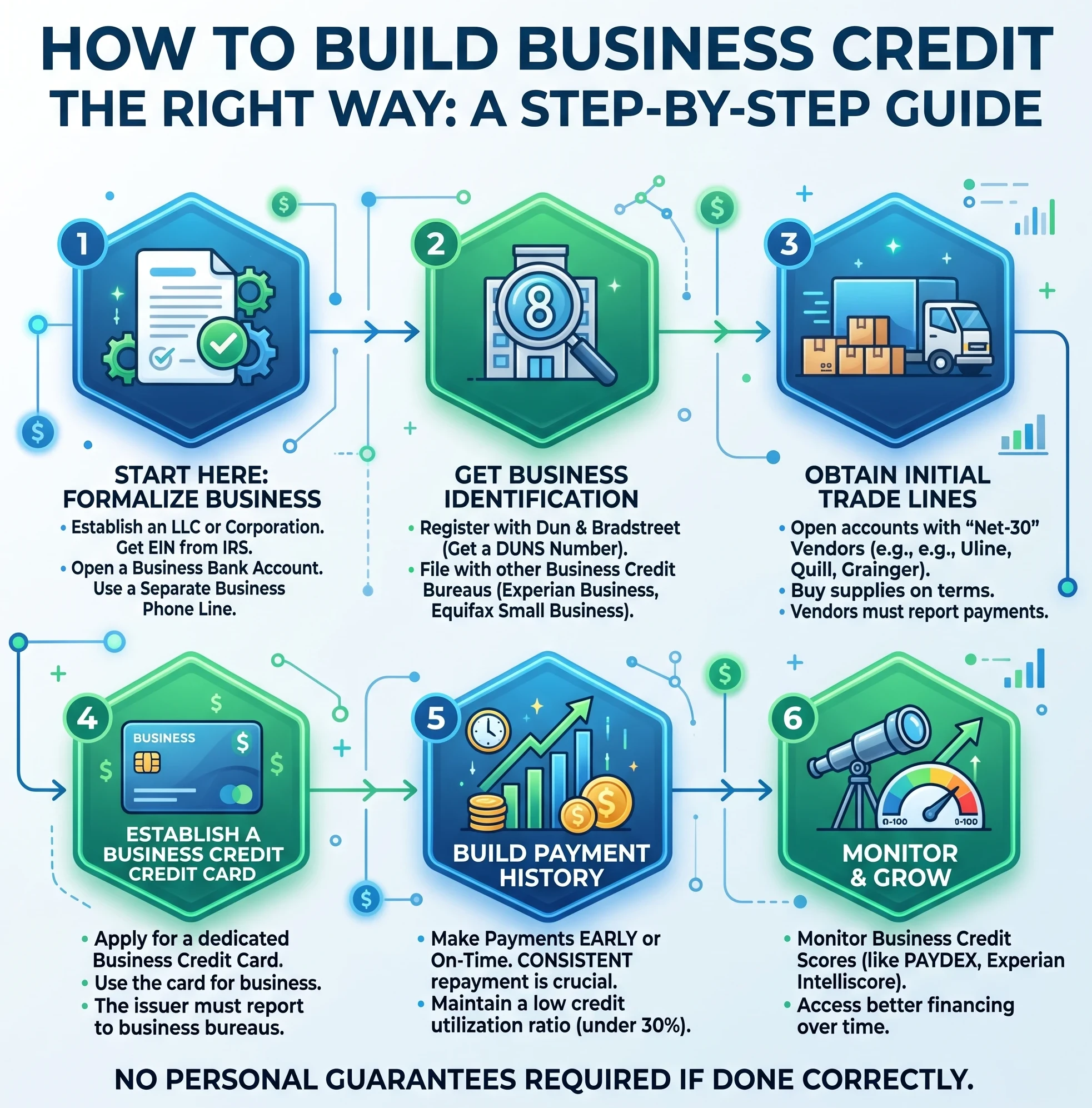
If you’re serious about growing your business, one of the most valuable assets you can build isn’t your website, your products, or even your customer list—it’s your business credit.
Strong business credit can open doors to financing, vendor relationships, equipment leasing, business credit cards, and larger growth opportunities. It can also reduce your dependence on personal credit and help protect your personal finances.
Unfortunately, many entrepreneurs don’t start thinking about business credit until they need a loan. By then, they may not have enough established credit history to qualify for favorable terms.
The good news is that building business credit doesn’t require you to be a large corporation. Whether you’re running an online business, a local service company, an eCommerce store, or a consulting agency, you can begin establishing business credit today.
In this comprehensive guide, you’ll learn how to build business credit the right way, avoid costly mistakes, and position your business for long-term financial success.
What Is Business Credit?
Business credit is a financial profile that reflects how responsibly your company manages borrowed money and payment obligations.
Think of it as a report card for your business’s financial behavior.
Instead of tracking your personal spending habits, business credit evaluates your company’s ability to:
- Pay suppliers on time
- Manage credit responsibly
- Handle business loans
- Maintain healthy financial relationships
- Demonstrate long-term financial stability
Lenders, suppliers, insurance companies, landlords, and even potential business partners may review your business credit before deciding whether to work with you.
A strong business credit profile signals that your company is trustworthy and financially responsible.
Why Business Credit Matters
Many new business owners rely on personal credit cards to fund their operations. While this may seem convenient, it can create long-term challenges.
Using personal credit for business expenses can:
- Increase your personal debt
- Lower your personal credit score
- Make tax preparation more difficult
- Expose your personal assets to financial risk
- Limit your business’s ability to qualify for financing independently
Building business credit separates your company’s financial identity from your personal finances.
Over time, this separation can help your business qualify for:
- Higher credit limits
- Better loan terms
- Lower interest rates
- Equipment financing
- Inventory financing
- Vendor credit accounts
- Commercial leases
- Government contracts
- Business insurance discounts
Simply put, business credit creates financial flexibility.
Personal Credit vs. Business Credit
Although they serve similar purposes, personal and business credit operate differently.
Personal Credit
Personal credit is tied to your Social Security Number and reflects your individual financial history.
It considers factors such as:
- Payment history
- Credit utilization
- Length of credit history
- Types of credit
- Recent credit inquiries
Personal credit follows you wherever you go.
Business Credit
Business credit belongs to your company.
It is linked to your business identification information rather than your personal identity.
Business credit evaluates:
- Vendor payment history
- Business loans
- Business credit cards
- Company financial stability
- Public business records
As your business grows, lenders may rely more heavily on your company’s credit profile than your personal credit history.
Benefits of Building Business Credit
Strong business credit offers advantages far beyond borrowing money.
Easier Access to Capital
Businesses with established credit profiles often have access to:
- Lines of credit
- Working capital loans
- Equipment financing
- SBA loans
- Commercial mortgages
Access to financing allows you to invest in growth opportunities without relying solely on personal savings.
Better Vendor Relationships
Many suppliers offer payment terms that allow you to receive products before paying the invoice.
Examples include:
- Net-30
- Net-45
- Net-60
These terms improve cash flow and help establish a positive payment history.
Higher Credit Limits
Businesses with strong credit profiles often qualify for higher limits on business credit cards and financing products.
Higher limits provide greater purchasing power while helping maintain lower credit utilization ratios.
Lower Interest Rates
Lenders reward businesses that demonstrate responsible financial management.
A stronger credit profile can lead to:
- Lower interest rates
- Reduced fees
- Better repayment terms
These savings can significantly reduce the cost of borrowing over time.
Protection of Personal Assets
One of the greatest benefits of business credit is separating your personal finances from your company’s obligations.
This separation can reduce personal financial risk and simplify bookkeeping.
Common Business Credit Myths
Many entrepreneurs misunderstand how business credit works.
Let’s clear up some common myths.
Myth #1: Only Large Companies Have Business Credit
False.
Small businesses, freelancers, online entrepreneurs, and startups can all establish business credit.
Myth #2: You Need Perfect Personal Credit
Not necessarily.
While some lenders review personal credit, building a strong business credit profile can increase financing opportunities over time.
Myth #3: Business Credit Happens Automatically
This is one of the biggest misconceptions.
Your business credit profile often needs to be actively established and built through responsible financial activity.
Myth #4: You Need Thousands of Dollars
Building business credit doesn’t require a large investment.
Many entrepreneurs begin by establishing vendor relationships and paying invoices on time.
Consistency matters far more than spending large amounts of money.
Step 1: Choose the Right Business Structure
The foundation of business credit begins with your legal business structure.
Although sole proprietorships can operate successfully, forming a separate legal entity often provides stronger credibility and better asset protection.
Common structures include:
Limited Liability Company (LLC)
An LLC is one of the most popular options for small business owners.
Benefits include:
- Liability protection
- Simpler taxes
- Professional credibility
- Easier separation of business and personal finances
Corporation
Corporations may be more appropriate for businesses planning to:
- Raise investment capital
- Expand nationally
- Issue stock
- Scale rapidly
Although corporations involve additional paperwork, they can provide advantages for larger operations.
Step 2: Register Your Business Properly
Once you’ve selected a business structure, register your business with the appropriate state or local agencies.
Maintain consistency across all records.
Your business name, address, phone number, website, and email should match everywhere they appear.
Consistency improves credibility and reduces confusion during financing applications.
Step 3: Obtain an EIN
An Employer Identification Number (EIN) functions like a Social Security Number for your business.
You’ll use it to:
- Open business bank accounts
- File taxes
- Hire employees
- Apply for vendor accounts
- Obtain financing
Using an EIN instead of your personal Social Security Number helps establish your business as a separate financial entity.
Step 4: Open a Business Bank Account
A dedicated business checking account is essential.
Never mix business and personal finances.
Use your business account for:
- Customer payments
- Vendor payments
- Payroll
- Operating expenses
- Business savings
Maintaining organized financial records improves your credibility with lenders and simplifies tax preparation.
Step 5: Build a Professional Business Presence
Before extending credit, many lenders and suppliers verify that your business appears legitimate.
Create a professional presence by establishing:
- A business website
- A custom domain email address (such as info@yourcompany.com)
- A dedicated business phone number
- A professional logo
- Consistent branding across social media profiles
- A complete “About Us” page
- Contact information
- Privacy Policy
- Terms and Conditions
How to Build Business Credit the Right Way (2026)
Part 2 of 5: Establishing Your Business Credit Profile and Building a Strong Financial Foundation
Why Your Business Credit Profile Matters
Now that you’ve legally established your business, opened a business bank account, and created a professional business presence, it’s time to begin building your actual business credit profile.
Many entrepreneurs mistakenly believe that simply forming an LLC or corporation automatically creates business credit. Unfortunately, that’s not how the process works.
Business credit must be earned through consistent financial activity. Every invoice you pay on time, every vendor account you manage responsibly, and every financial obligation you meet contributes to your company’s reputation.
Think of your business credit profile as a long-term investment. The earlier you start building it, the more opportunities become available as your business grows.
How Business Credit Is Created
Unlike personal credit, which often begins when you open your first credit card or loan, business credit starts only after your company begins establishing financial relationships that are reported to business credit agencies.
These relationships can include:
- Vendor accounts
- Business credit cards
- Equipment financing
- Commercial loans
- Business lines of credit
- Trade credit
- Leasing agreements
Each positive payment contributes to your company’s overall financial reputation.
The key is consistency.
Understanding Business Credit Reporting
Business credit reporting differs from personal credit reporting in one important way:
Not every lender or supplier reports payment history.
That means you could be paying dozens of invoices on time every month, but if your vendors don’t report your payment activity, your business credit profile may show very little activity.
This is why selecting reporting vendors is an important part of your credit-building strategy.
What Information Appears on Your Business Credit Report?
Your business credit report may include information such as:
Basic Business Information
- Business name
- Business address
- Phone number
- Industry classification
- Years in business
- Business ownership
- Number of employees
Keeping this information accurate across all business registrations helps establish credibility.
Payment History
Payment history is often one of the most influential factors in your business credit profile.
Lenders want to know:
- Do you pay invoices on time?
- Do you consistently pay early?
- Have you ever defaulted on obligations?
Businesses with strong payment histories are generally viewed as lower-risk borrowers.
Credit Accounts
Your report may include:
- Vendor credit
- Business credit cards
- Loans
- Equipment financing
- Lines of credit
The more positive accounts you establish over time, the stronger your overall credit profile becomes.
Public Records
Business credit reports may also contain public information such as:
- Bankruptcies
- Tax liens
- Court judgments
- Business registrations
Maintaining good legal standing helps support a healthy business credit profile.
The Importance of Payment History
If there is one factor that consistently influences business credit, it’s payment history.
Paying every invoice on or before its due date demonstrates financial responsibility.
Many businesses go one step further by paying invoices early whenever possible.
Benefits of paying early include:
- Stronger relationships with suppliers
- Improved reputation
- Better opportunities for higher credit limits
- Increased confidence from future lenders
Late payments, on the other hand, can damage your reputation and make financing more difficult.
Start Small and Build Gradually
One of the biggest mistakes new entrepreneurs make is trying to obtain too much credit too quickly.
Instead, focus on building a strong foundation.
A gradual approach allows your business to demonstrate responsible borrowing habits before seeking larger financing opportunities.
Think of business credit as climbing a ladder:
- Establish a few trade accounts.
- Pay every bill on time.
- Add a business credit card.
- Maintain low balances.
- Increase available credit over time.
- Apply for larger financing only when your business is financially ready.
Slow, consistent progress is often more effective than rapid expansion.
Understanding Vendor Credit
Vendor credit is one of the easiest ways for new businesses to begin establishing payment history.
A vendor extends credit by allowing your business to receive goods or services before payment is due.
For example:
A supplier ships office supplies today and allows payment within 30 days.
This arrangement gives your company time to generate revenue before paying the invoice.
When managed responsibly, vendor accounts help establish positive payment records.
What Are Net-30 Accounts?
One of the most common vendor payment arrangements is called a Net-30 account.
Net-30 simply means payment is due within 30 days after the invoice date.
Other common payment terms include:
- Net-15
- Net-45
- Net-60
- Net-90
Longer payment periods improve cash flow while giving businesses additional flexibility.
Why Vendor Accounts Matter
Vendor credit offers several advantages beyond building business credit.
Benefits include:
- Improved cash flow
- Easier inventory management
- Increased purchasing flexibility
- Stronger supplier relationships
- Opportunities for higher credit limits over time
Even businesses with modest purchasing needs can benefit from responsibly managing vendor accounts.
Choosing Vendors Wisely
Not every supplier reports payment history.
Before opening a trade account, confirm whether the vendor reports to business credit reporting agencies.
If your goal is building business credit, reporting vendors provide greater long-term value than vendors that don’t report payment activity.
Develop Strong Supplier Relationships
Business credit isn’t just about numbers.
It’s also about trust.
Businesses that communicate openly, pay consistently, and honor agreements often develop stronger relationships with suppliers.
These relationships may lead to:
- Higher purchasing limits
- Better payment terms
- Priority service
- Preferred pricing
- Easier financing approvals
Treat every supplier relationship as an investment in your company’s future.
Keep Excellent Financial Records
Good bookkeeping supports strong business credit.
Maintain organized records of:
- Invoices
- Receipts
- Bank statements
- Loan agreements
- Tax filings
- Vendor contracts
Accurate financial records make it easier to apply for financing and demonstrate responsible financial management.
Separate Personal and Business Expenses
One of the most common mistakes entrepreneurs make is using personal accounts for business purchases.
Doing so creates confusion and makes it more difficult to establish an independent business credit history.
Instead:
- Use your business bank account for all company income.
- Pay business expenses from business accounts.
- Use business credit products for company purchases.
- Keep personal expenses completely separate.
Financial separation strengthens your company’s credibility.
Monitor Your Cash Flow
Cash flow is the lifeblood of every business.
Even profitable businesses can experience financial stress if cash isn’t available when bills are due.
Monitor:
- Monthly revenue
- Operating expenses
- Outstanding invoices
- Upcoming payments
- Emergency reserves
Healthy cash flow helps ensure that you never miss important payment deadlines.
Avoid These Business Credit Mistakes
Many entrepreneurs unintentionally damage their business credit by making avoidable errors.
Common mistakes include:
- Missing payment due dates
- Paying invoices late
- Mixing personal and business finances
- Ignoring bookkeeping
- Applying for excessive credit in a short period
- Failing to review business credit reports
- Closing long-standing business accounts without considering the impact
- Borrowing more than the business can comfortably repay
Avoiding these pitfalls can save your business time, money, and future financing opportunities.
Internal Linking Opportunities
As you expand your website, consider linking this guide to related articles such as:
- How to Start an Online Business
- How to Register an LLC
- Beginner’s Guide to Small Business Taxes
- Best Business Bank Accounts for Entrepreneurs
- How to Improve Cash Flow
- How to Create a Business Budget
- Affiliate Marketing for Beginners
- How to Build a Website That Makes Money
- Email Marketing for Small Businesses
These supporting articles help create a topical content cluster that strengthens your website’s authority in Google’s search results.
Affiliate Opportunity
If you’re building an online business from home, one of the best investments you can make is learning proven marketing skills.
A comprehensive training platform can teach you how to:
- Build a professional website
- Attract free traffic through SEO
- Create valuable content
- Grow an email list
- Monetize your website with affiliate marketing
- Scale your business over time
As your website attracts more visitors, strong business credit and consistent revenue can work together to support future growth and expansion.
Key Takeaways
At this stage, your goal isn’t to borrow large sums of money—it’s to establish trust.
Focus on building a solid financial foundation by maintaining accurate records, paying every invoice on time, using vendor credit responsibly, and keeping your business finances separate from your personal accounts. These habits may seem simple, but over time they create the credit profile that lenders and suppliers value most.
Remember, business credit is built through consistency rather than speed. Every positive payment strengthens your company’s reputation and moves you one step closer to qualifying for better financing options.
Build Your Business Credit the Right Way with Credit Suite
Building business credit doesn’t have to be confusing or overwhelming. With the right strategy and expert guidance, you can establish a strong business credit profile, qualify for higher funding limits, and position your company for long-term success.
Credit Suite provides the education, tools, and professional Credit Money Managers to help you every step of the way. Whether you’re just starting your business or looking to access more financing, their experienced team can walk you through the process of building business credit correctly and help you identify the best funding opportunities for your unique situation.
Don’t let a lack of funding hold your business back. Take the next step toward financial freedom and business growth by learning how to build your business credit the right way. With expert support and a proven system, you’ll have the confidence to secure the capital you need to start, grow, and scale your business.
Ready to unlock more funding opportunities? Learn how to build your business credit the right way with Credit Suite and let their professional Credit Money Managers guide you toward the financing your business deserves.
Leave a Reply